 A view of Elsinore Castle from the ferry into Helsingør from Sweden.
Thursday, August 25, 2011

Swedish meatballs
 I'd had the Danish frikadeller and even cooked a batch one afternoon stuffed with Danablu. They were glorious. But Swedish köttbullar are something else entirely. Carrots, potatoes, pickled cucumbers and lingonberry jam on the side. Such rustic stuff, but exquisitely satisfying. The brunsås, or brown sauce, makes the dish. I had mine at a hotel cafe in Helsingborg by the bay, with a view across the Øresund at Helsingør/Elsinore and the castle on the coast where Hamlet used to brood.
Copenhagen Fashion Week
 The Monocle's Tom Morris and Dan Hill think Copenhagen is becoming the world's "green laboratory", and here's a pedestrian street smack in the center of town with grass instead of asphalt. How cool would a neighborhood of streets like that be? I especially dig the outdoor cafe seating. Later that night, a DJ booth was set up at one of the intersections as part of Fashion Week and the street was filled with chic barefooted party-goers bopping their heads and swigging Carlsbergs.

Wednesday, August 10, 2011
Heisenberg and Bohr in Copenhagen
In 1924 Werner Heisenberg began studying with the director of the Institute of Theoretical Physics at the University of Copenhagen, Niels Bohr. In September 1941 Heisenberg returned to Copenhagen to meet his old professor. He later wrote: "Late at night I walked under a clear and starry sky through the city, darkened, to Bohr."
They met at Bohr's home and took a walk through Ny-Carlsberg together. Heisenberg had come to talk to Bohr about "whether or not it was right for physicists to devote themselves in wartime to the uranium problem". Heisenberg was 39 then. Bohr was 55. Bohr was under German surveillance so Heisenberg only felt safe speaking in the vaguest of terms.
Unfortunately, this led Bohr to misread Hiesenberg and take all his foggy speech about nuclear weapons to mean that the Germans were in fact close to having one. Heisenberg could see what Bohr was thinking, but was too afraid to speak directly to clear the matter up. They argued about it for years, who'd said what to whom and what they'd meant and how it was taken. Later, historians inherited the problem.
I still like to imagine them, teacher and student, strolling down a dark Copenhagen alley and whispering about nuclear technology like a pair of spies.
Tuesday, August 9, 2011
Accomplishments by age
1: Christian Heinecken read the Pentateuch.
3: Mozart learned the harpsichord.
7: Fred Astaire performed on stage.
15: Bobby Fischer became a grandmaster.
17: Pele played in the World Cup final.
23: Keats wrote "Ode on a Grecian Urn".
25: Orson Welles wrote and directed Citizen Kane.
27: Hemingway wrote his first novel, The Sun also Rises.
33: Emerson wrote "Nature".
37: Michelangelo finished the Sistine Chapel.
45: Foreman won the heavyweight title.
48: Umberto Eco wrote his first novel, The Name of the Rose.
54: Beethoven completed the 9th.
55: Picasso painted Guernica.
75: Hokusai painted 100 views of Fuji.
89: Schweitzer ran a hospital in Africa.
3: Mozart learned the harpsichord.
7: Fred Astaire performed on stage.
15: Bobby Fischer became a grandmaster.
17: Pele played in the World Cup final.
23: Keats wrote "Ode on a Grecian Urn".
25: Orson Welles wrote and directed Citizen Kane.
27: Hemingway wrote his first novel, The Sun also Rises.
33: Emerson wrote "Nature".
37: Michelangelo finished the Sistine Chapel.
45: Foreman won the heavyweight title.
48: Umberto Eco wrote his first novel, The Name of the Rose.
54: Beethoven completed the 9th.
55: Picasso painted Guernica.
75: Hokusai painted 100 views of Fuji.
89: Schweitzer ran a hospital in Africa.
Thursday, August 4, 2011
Dark dark Prag
 When Milos Forman shot Amadeus he did it in Prague because, he said, "Communist inefficiency" had left the city as it was in the 18th century. It's also one of the best to survive WWII thanks to an epic defeat of the Nazis by Prague citizens and a deal they made not to drown the bastards if they left without damaging the beloved city. How to describe Prague?
It never lets you go, said Kafka, "this dear little mother has sharp claws." For Wagner, its beauty "left an impression...that will never fade". For Rodin, "the women of Prague, the way they walk and the way they are attired, so graceful and elegant, reminded me of Dante’s Paradise".
For me, it's a place best visited in the rain. The architectural splendor of Prague reaches the limits of beauty, but like Amsterdam this beauty comes with a sordid past. The darkness of the Jewish ghetto. Don Giovanni. Mucha. Kafka. Dvořák. Smetana. Freud. Husserl. Stoppard. Such exquisitely painful, frighteningly beautiful minds. What can one possibly say?
Nothing new comes from Prague now. Nothing I know of. Its buildings, its past, its music, are all untouchably lovely but utterly done. Prague is the world's prettiest museum, but who wants to live in a museum? No trip to Europe can possibly be complete without seeing a place as profoundly eye-opening and heart-rending as this is, but it isn't a place for a home. Not for me.
I went to this introductory program before my freshman year of uni and on the trip they took us to Frank Lloyd Wright's Falling Water and had us sit by a river and listen to Smetana's Moldau and then guess what it was about. I was the only one who figured it was about a river, but I'd never have guessed about the fairies and the hunters. It all sounded so sad to me. Seeing Prague, I get why. Even in a world of wonder, as Prague is, life is suffused with pain.
Mozart's Prague
 "Meine Prager verstehen mich," Mozart once said. My Praguers understand me. According to Maynard Solomon's "Mozart: A Life", when The Marriage of Figaro opened in Prague after its Vienna premiere it was met with "unlimited applause". In Prague, he was beloved. His Prague fans even paid for him to visit them in 1787 to see the show himself. A week later he gave a private performance on 19 January 1787 where he played Symphony No.38 in D major for the first time. It became known as the Prague Symphony and Mozart considered that day one of the happiest of his entire life.
The Prague Symphony begins patiently. Such lazy starts were rare for Mozart's symphonies. Only the 36th and 39th share this. But you can hear echoes of the Don Giovanni overture here. The second movement isn't as tight as a typical Mozart, but the third slips in a flirty nimble flute. Anthony Hopkins (English composer, not the Welsh actor) said about the third movement that it "shows Mozart in an unusual mood, nearer to Beethoven's boisterousness than his fastidious taste normally allowed him to go."
The Viennese public was fickle toward Mozart. They hated him, they loved him. They loved him, they hated him. Allegedly when Emperor Joseph II heard The Abduction from the Seraglio, he said it had too many notes. But in Prague, no one questioned his genius. After Prague was absorbed by the Catholic Austrian Empire, part of the assimilation process involved requiring every teacher to compose and perform church music with their students. It not only helped turn them into Catholics, it made them avid musicians -- and lovers of the likes of Mozart. Plus, all the stuffy Prague nobles had left for the new capital in Vienna and what they left behind were a load of middle-class merchants who'd been musically educated through the Church but unlike their royal rulers, liked whatever was new.
But despite all the adoring fans, Mozart eventually left Prague. The musicians there simply weren't as good as in Vienna. Even the Praguers who could play well went to the new capital for work, and so did Mozart. But it was here that Mozart composed Don Giovanni in this very building. It's maybe the only one still standing in which Mozart worked, and performances of Don Giovanni can be seen here every night at 8PM. Kierkegaard adored Don Giovanni, thought it was one of the greatest works of art in history and wrote about it at length (and boringly, I find) in Either/Or. Flaubert said the three greatest things God ever created were the ocean, Hamlet and this opera.
Jan Hus
 In the center of Prague a statue of Jan Hus watches over Týn Church. In the early 1400s Jan figured the Church should stop with the indulgences and Crusades. He wanted freedom for the Bohemian people too. The Church locked him up for a few years, then asked him if he still felt the same way. When he said yes, they burned him alive. Then to make sure he was really dead they ripped out his heart, nailed it to a stick and burned it again. Then they crushed his bones to dust. But too late for his ideas had already caught on and his followers, the Hussites, went on to profoundly influence what would become Protestantism. Prague was in fact one of the first Protestant cities. Interesting side note: while he was burning an old lady is said to have thrown a handful of sticks on the fire. Hus cried out "Sancta simplicitas!" or "Holy simplicity!" Czechs still say this, though in Czech ("Svatá prostoto!") when they see folks doing stupid things.
Alfons Mucha
 Alfons Mucha (moo-ka) started as a humble painter and wound up a tool for Czech nationalism. In the end he painted bank notes, murals in government buildings, designed stamps, and his Art Nouveau style (characterized by floral, organic lines) is seen all over Prague today. For example the font of the Hotel Paris. Mucha was arrested by the Gestapo in 1939 and interrogated. He became ill and died shortly after his release.
My favorite Mucha lithographs are his 1896 ad for Biscuits Lefèvre-Utile and his 1897 Bières de la Meuse, which decorated my kitchen when I was in uni.

 His style essentially founded Art Nouveau, which went on to influence Klimt and Gaudí as well as a number of Japanese manga artists and Cuban-American artist Joe Quesada, who did this image of Wolverine with Emma Frost and a katana.
Golem
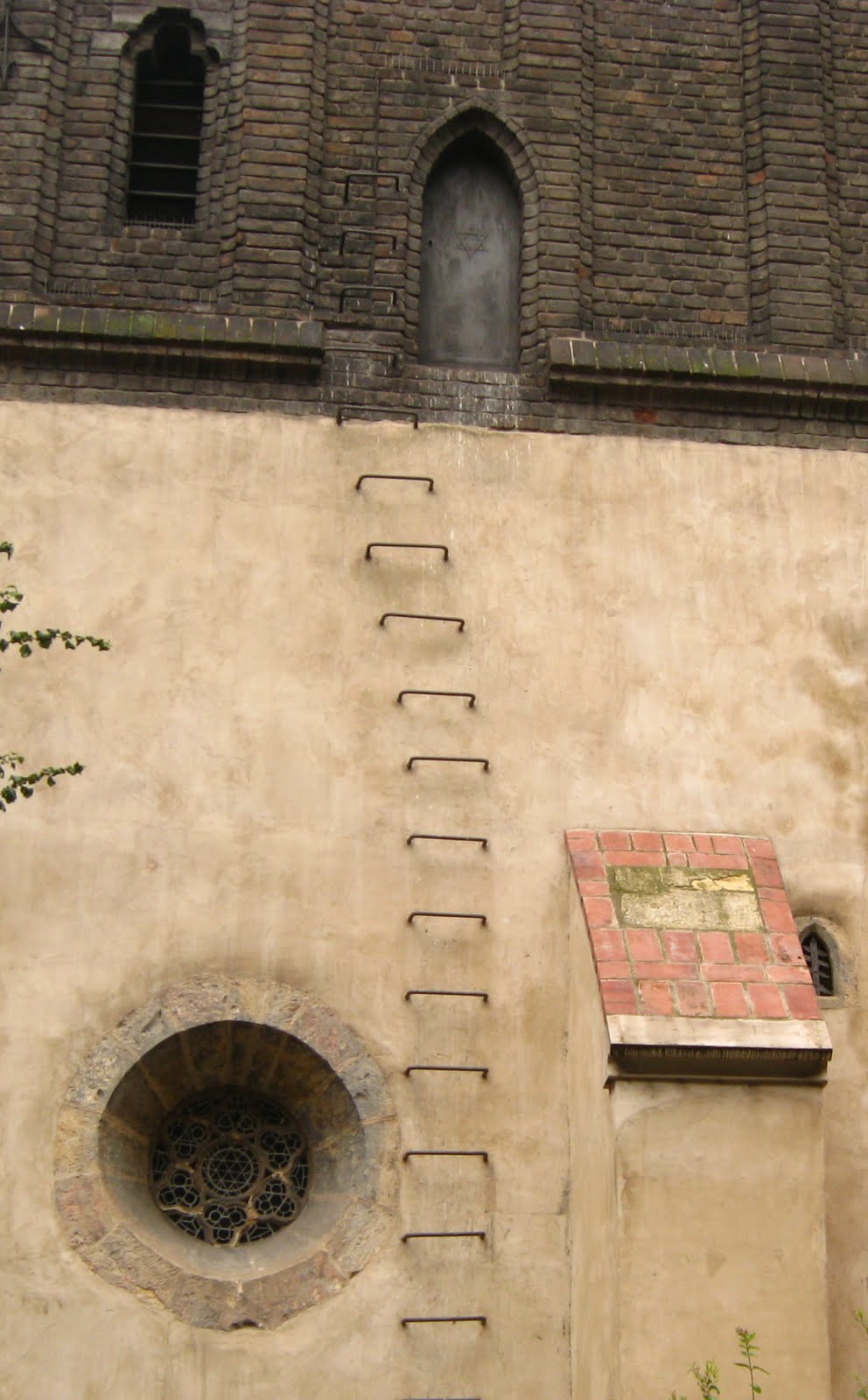 Legend says 16th century rabbi Judah Loew ben Bezazel, the Maharal of Prague, made a man from clay and named it Golem. By writing the Hebrew word for 'life' on a slip of paper and putting it in the Golem's mouth, it came to life. Jorge Luis Borges described the Golem's awakening in a poem:
El rabí le explicaba el universo
"esto es mi pie; esto el tuyo, esto la soga."
y logró, al cabo de años, que el perverso
barriera bien o mal la sinagoga.
The rabbi explained the universe
"this is my foot; that is yours, this is rope."
and succeeded, after years, that the perverse
swept well or poorly the synagogue.
The rabbi explained the universe
"this is my foot; that is yours, this is rope."
and succeeded, after years, that the perverse
swept well or poorly the synagogue.
According to other tales, the Golem not only swept the synagogue but protected the entire Jewish ghetto. But one day the Maharal forgot to remove the slip of paper from the Golem's mouth and he went mad from lack of sleep, throwing Praguers into the river and tearing up the streets. The Maharal rushed out in the middle of a sermon and stopped the Golem.
Its large clay body was stored in the attic of the Old New Synagogue, the oldest active synagogue in Europe. Hundreds of years later, a Nazi officer crept into the attic to see if the stories were true. They found his crushed body in the middle of the synagogue lawn. Pictured here are the rungs leading to the door of the synagogue's attic.
The synagogue itself is simple, but pretty. They say it was built with stones taken from a temple in Jerusalem, to be returned again once the Messiah appears. Not a bad deal, if you ask me.
Subscribe to:
Posts (Atom)